
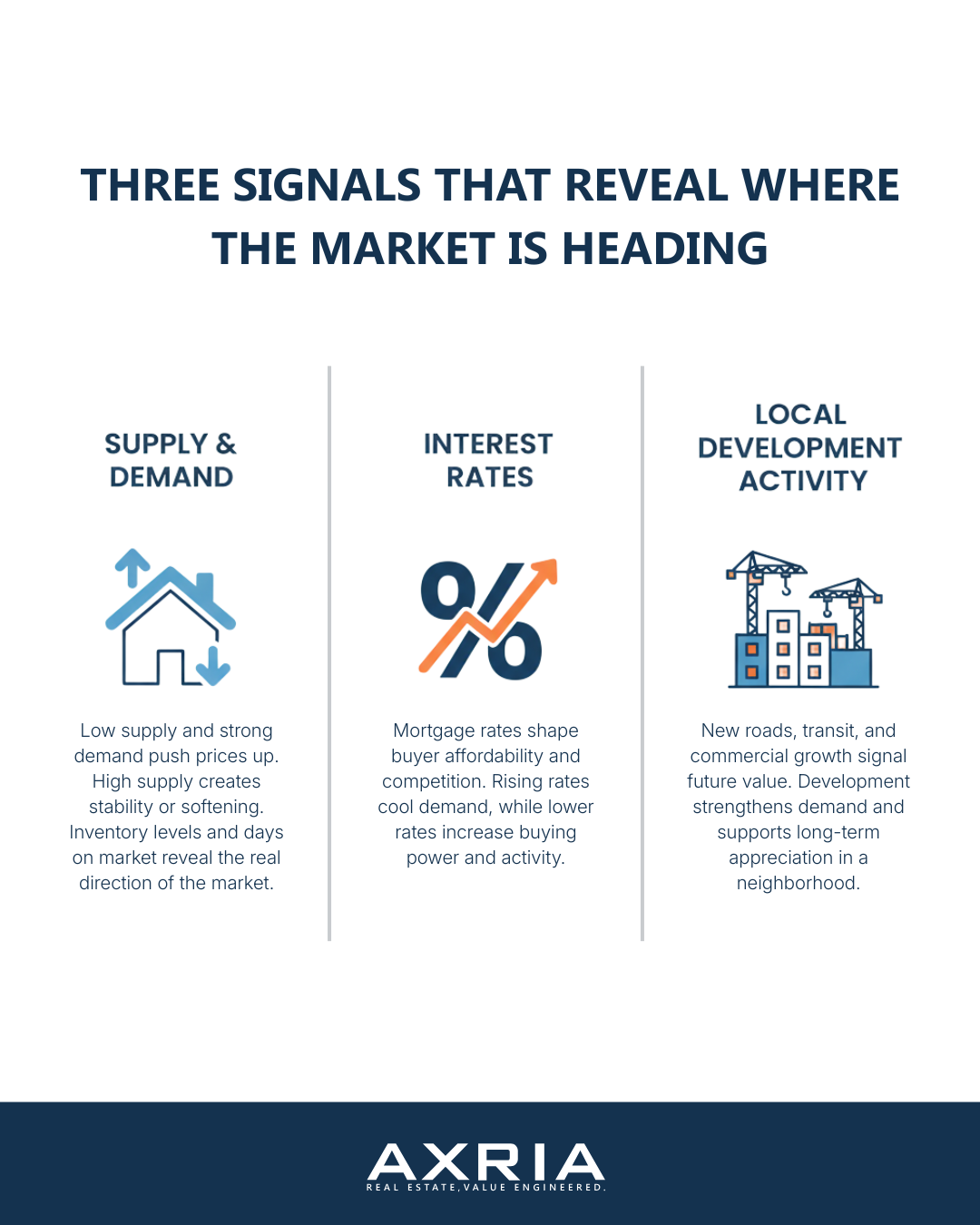
Real estate markets can feel complicated, but they become clearer when broken down into simple indicators. Buyers do not need prediction. They need structure. Three fundamental signals reveal more about the direction of the market than any headline or forecast. These are supply and demand, interest rates, and local development activity.
Understanding these signals helps buyers make disciplined decisions based on fundamentals rather than speculation. This is the same approach that disciplined developers use to evaluate risk and long-term value.
The First Signal: Supply and Demand
Supply and demand remain the most reliable guide to market conditions.
When supply is tight and demand is strong, prices tend to rise, listings move quickly, and buyers compete. When inventory increases or demand softens, the market shifts toward stability. Prices moderate. Days on market rise. Buyers gain leverage.
These changes can be seen early by tracking three basic indicators.
First, the number of active listings in the region.
Second, the average days on market for recently sold properties.
Third, the months of supply, which measures how long current inventory would last at the current sales pace.
If months of supply drop below six, the market favors sellers. If it rises above six, buyers gain negotiation power. This simple metric prevents emotional decision making and helps buyers understand whether prices are likely to rise, stabilize, or soften.
Supply and demand do not require forecasting. They require attention to the data that is already visible.
The Second Signal: Interest Rates
Interest rates shape affordability and buyer activity more directly than any other financial factor.
When interest rates rise, monthly payments increase and purchasing power decreases. Fewer buyers qualify for financing. Demand cools. When rates fall, affordability improves, and more buyers enter the market. Competition increases and prices often follow.
Watching rate trends helps buyers predict how competitive a market may become.
Two points matter most.
First, the direction of rate movement over the past several months.
Second, the signals from major financial institutions about credit conditions.
Buyers often focus on small changes in price while ignoring the larger effect of interest costs. A one percent shift in mortgage rates can alter purchasing power by close to ten percent. Understanding this gives buyers clarity about timing and affordability.
Interest rates do not tell buyers when to act, but they tell buyers how conditions will change. That insight is essential.
The Third Signal: Local Development Activity
The third signal is often overlooked but highly predictive. Local development activity reveals how an area is likely to perform in the future.
New roads, transit improvements, commercial expansion, and new housing construction all point to strengthening demand. Communities with active development attract residents, businesses, and long-term investment. Over time, this creates appreciation that is supported by real infrastructure rather than speculation.
Three indicators help buyers understand development momentum.
First, building permits issued in the area.
Second, planned infrastructure projects such as transit upgrades or road expansions.
Third, announcements from major employers or educational institutions.
When these factors align, neighborhoods grow more desirable. This leads to stronger rental markets, higher occupancy, and long-term price stability. Development activity is a forward-looking signal that helps buyers see value before it becomes obvious.
Why These Three Signals Matter
These three signals work because they are based on fundamentals. They do not rely on predictions or expert guesses. They reflect real conditions and real demand.
Buyers who understand these indicators gain a clearer perspective on risk, opportunity, and timing. They begin to view real estate not as a series of short-term movements but as a system driven by structure. That mindset leads to disciplined decisions and long-term stability.
This approach reflects the same philosophy that guides Axria. Our teams evaluate supply conditions, rate environments, and development patterns before committing to any project. This discipline ensures that decisions are grounded in fundamentals that remain relevant through every phase of the market cycle.
Axria’s View
At Axria, we believe that reading the market is not complicated. It is structured.
We study these signals because they reflect long-term value, not short-term noise.
Our integrated model allows us to act with discipline when these fundamentals align.
This mindset protects investor capital and strengthens the performance of our developments across the NJ and PA corridor.
Market cycles will continue to change. Fundamentals do not.
Conclusion
Real estate becomes easier to understand when buyers focus on the right signals. Supply and demand reveal the immediate balance in the market. Interest rates shape affordability and demand pressure. Local development activity shows the direction of future growth.
These indicators help buyers make confident, disciplined decisions based on structure, not speculation. They create clarity in uncertain times and support long-term value creation for households and investors.
Frequently Asked Questions
Why do interest rates matter so much?
Interest rates determine how much a buyer can afford to borrow. When rates rise, monthly mortgage payments increase, which reduces purchasing power and lowers the number of qualified buyers in the market. When rates fall, affordability improves and buyer activity strengthens. These movements influence pricing, competition, and overall demand. Understanding rate trends helps buyers anticipate how the market may shift over the next several months.
How can I track local development activity?
Local development can be monitored by watching new building permits, infrastructure upgrades, zoning changes, and planned commercial or institutional projects. City planning boards, municipal websites, transit authorities, and local business news often publish updates. Major employer expansions, new schools, hospitals, or transportation projects are strong indicators of long-term value growth in the surrounding area.
Do these signals work in all markets?
Yes. Supply and demand, interest rates, and development activity are fundamental indicators across all types of markets. Whether you are evaluating a city center, a suburban neighborhood, or a mixed-use district, these signals offer a reliable framework for understanding direction and stability. They are used by professional developers and investors regardless of geography.
What is the simplest way to read the market quickly?
Focus on three data points: current inventory levels, recent mortgage rate movements, and any visible development activity in the area. If inventory is tight, rates are stable or falling, and new investment is occurring nearby, the market is likely strengthening. If inventory is rising, rates are high, and development is limited, conditions may be stabilizing or cooling. These metrics provide a fast and accurate snapshot without needing complex analysis.
